In Part 1, we proved vertical monotonicity for positive solutions of a Serrin problem on an epigraph under a monotonicity condition on \(f(s)/s\) and (G). In this post we use that result twice, on both sides of the zero set of a solution of the Allen–Cahn equation
\[-\Delta u=u-u^3\]in \(\mathbb R^n\). The simplest solutions are the one-dimensional ones,
\[u(x)=\tanh\left(\frac{x\cdot\xi-b}{\sqrt2}\right),\qquad |\xi|=1,\quad b\in\mathbb R.\]De Giorgi’s conjecture (1978) says that monotonicity forces this rigidity in low dimensions: if \(\partial_nu>0\) and \(n\le8\), then \(u\) is one of the solutions above.
The converse question
If you believe in this conjecture or OpenAI’s proof of this conjecture, then the explicit form of the solutions above shows that the level sets of monotone solutions are parallel hyperplanes. In particular, the zero set is an entire graph,
\[\{u=0\}=\{x_n=g(x')\}\qquad (\mathrm{N})\]for some \(g\in C^2(\mathbb R^{n-1})\). This post is about the converse: if we only know that the zero set is an entire graph, must \(u\) be monotone? A priori, (N) gives much less information. It says nothing about the other level sets, and nothing about \(u\) far from the interface.
Questions of this type have been studied before. Farina and Valdinoci proved that a monotone solution one of whose level sets is an entire graph is one-dimensional when \(n\le8\). Very recently, Farina posted a manuscript, dated 2016, whose Theorem 11.2 proves by the sliding method that if the zero set of \(u\) is the graph of a uniformly continuous function, then \(u\) is one-dimensional in every dimension; in dimension two, continuity suffices (Remark 18 there). Some condition at infinity is necessary for flatness when \(n\ge9\): the del Pino–Kowalczyk–Wei solutions have graphical zero sets that grow cubically in both directions. The theorem below shows that monotonicity, on the other hand, needs no condition on \(g\) at infinity, in any dimension.
Theorem (a graphical zero set forces monotonicity). Let \(u\in C^2(\mathbb R^n)\) solve \(-\Delta u=u-u^3\), and suppose that (N) holds for some \(g\in C^2(\mathbb R^{n-1})\). Then, up to replacing \(u\) by \(-u\), we have \(\partial_nu>0\) in \(\mathbb R^n\). If moreover \(n\le8\), or there exists $C>0$ such that \(g(x')\le C(1+\lvert x'\rvert)\) for all \(x'\), or \(g(x')\geq-C(1+\lvert x'\rvert)\) for all \(x'\), then
\[u(x)=\tanh\left(\frac{x\cdot\xi-b}{\sqrt2}\right)\]for some unit vector \(\xi\) with \(\xi_n>0\) and some \(b\in\mathbb R\).
A uniformly continuous function grows at most linearly, so for \(C^2\) graphs the flatness statement of the theorem includes Farina’s theorem.
Proof of the Theorem
Up to replacing \(u\) by \(-u\), which is again a solution, we may assume that \(u>0\) above the graph of \(g\) and \(u<0\) below it. The idea is to apply Part 1 in each phase. Above the graph, \(u\) is a positive solution of a Dirichlet problem in an epigraph. Below the graph, \(-u\) is positive, and reflecting both the vertical coordinate and the sign of \(u\) turns the lower phase into an epigraph as well. It is easy to check that \(f(s)=s-s^3\) satisfies \(h(s)=f(s)-sf'(s)\ge 0\) for \(s>0\), and again (G) holds trivially as \(\lvert u\rvert<1\) by Theorem 1.1 of Farina.
Step 1: the interface. Let \(\Omega_+=\{x_n>g(x')\}\) and let \(p\) be a point of \(\partial\Omega_+\). In \(\Omega_+\) we have \(u>0\) and \(-\Delta u=(1-u^2)u\geq0\), and \(\Omega_+\) satisfies the interior ball condition at \(p\) because \(g\in C^2\). Hopf’s lemma gives \(\partial_\nu u(p)<0\), where \(\nu\) is the outer normal of \(\Omega_+\). Since \(u\) vanishes on \(\partial\Omega_+\), its gradient is normal there, so
\[\nabla u(p)=\partial_\nu u(p)\,\nu,\qquad \nu=\frac{(\nabla g,-1)}{\sqrt{1+|\nabla g|^2}},\qquad \partial_nu(p)=\frac{-\partial_\nu u(p)}{\sqrt{1+|\nabla g|^2}}>0 .\]Step 2: the upper phase. In \(\Omega_+\), \(u\) is a bounded positive solution of \(-\Delta u=f(u)\), \(u=0\) on \(\partial\Omega_+\), and \(\partial_nu>0\) on \(\partial\Omega_+\) by Step 1. This is exactly the setting of Part 1. The quotient argument gives \(\partial_nu\geq0\) in \(\Omega_+\), and the strong maximum principle upgrades it to \(\partial_nu>0\).
Step 3: the lower phase, by a double reflection. Define
\[v(x',t)=-u(x',-t),\qquad \widetilde\Omega=\{(x',t):t>-g(x')\}.\]The point \((x',t)\) lies in \(\widetilde\Omega\) exactly when \((x',-t)\) lies in \(\{u<0\}\), so \(v>0\) in the epigraph \(\widetilde\Omega\) of \(-g\in C^2\), and \(v=0\) on its boundary. Since \(f\) is odd, \(-\Delta v=v-v^3\). Finally, the two minus signs cancel in the vertical derivative:
\[\partial_tv(x',t)=\partial_nu(x',-t).\]The argument of Part 1 can thus be applied again to \(v\), giving \(\partial_tv>0\) in \(\widetilde\Omega\), that is, \(\partial_nu>0\) in \(\{u<0\}\). Together with the preceding steps, this gives \(\partial_nu>0\) throughout \(\mathbb R^n\).
This completes the proof of monotonicity.
Flatness. By monotonicity, \(\partial_nu>0\). Moreover, \(u\) tends to \(\pm1\) as \(x_n\to\pm\infty\): by Lemma 11.3 of Farina, a solution of the Allen–Cahn equation with \(0<u\le1\) in a continuous epigraph tends to \(1\) uniformly as the distance to the boundary tends to infinity; apply it to \(u\) above the graph of \(g\) and to \(-u\) below it. These are exactly the hypotheses of Savin’s theorem, which gives that \(u\) is one-dimensional when \(n\le8\); see Theorem 1.3 of Savin’s 2016 note. For the one-sided linear bounds, Theorem 1.4 of the same note says that if, in addition, \(\{u=0\}\subset\{x_n<C(1+\lvert x'\rvert)\}\), then \(u\) is one-dimensional in every dimension. If \(g(x')\le C(1+\lvert x'\rvert)\), this inclusion holds with \(2C\) in place of \(C\). If instead \(g(x')\geq-C(1+\lvert x'\rvert)\), apply the same argument to \(\tilde u(x',x_n)=-u(x',-x_n)\), which satisfies all the assumptions of the theorem with \(-g\) in place of \(g\). \(\square\)
Remark on the regularity of \(g\). We assumed \(g\in C^2\) only to apply Hopf’s lemma in Step 1, which needs the interior ball condition. Local Lipschitz continuity of \(g\) suffices, because of the following claim: if \(g\) is locally Lipschitz, then \(\nabla u\neq0\) on the zero set. Recall that \(u\) is real-analytic by Theorem 1.1 of Farina. Given the claim, let \(p\) be a point of the zero set, so that \(p=(p',g(p'))\). By the implicit function theorem, near \(p\) the zero set is a \(C^1\) hypersurface whose tangent plane is orthogonal to \(\nabla u(p)\). Since it is also the graph of a function that is \(L\)-Lipschitz near \(p'\), it lies near \(p\) in the double cone \(\{\lvert x_n-g(p')\rvert\le L\lvert x'-p'\rvert\}\), so every tangent vector \(v\) satisfies \(\lvert v_n\rvert\le L\lvert v'\rvert\). Hence \(e_n\) is not tangent (as that would imply \(1\le 0\)), so it is not orthogonal to \(\nabla u(p)\), which implies that \(\partial_nu(p)=\nabla u(p)\cdot e_n\neq0\). As \(u>0\) above the graph and \(u<0\) below it, \(\partial_nu(p)\ge0\), so \(\partial_nu(p)>0\). Since \(u\) is real-analytic and \(\partial_nu(p)\neq0\), the analytic implicit function theorem in the variable \(x_n\) now shows that \(g\) is real-analytic near \(p'\). In particular \(g\in C^2\), so the original proof applies without change.
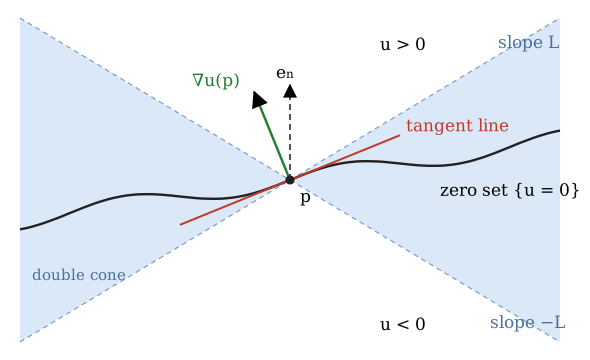
Proof of the claim. Suppose, for a contradiction, that there is a point \(p\) in the zero set with \(\nabla u(p)=0\). By translating coordinates, we may assume that \(p=0\), since the Allen–Cahn equation and the locally Lipschitz graph condition are preserved under translations. Thus \(u(0)=0\) and \(\nabla u(0)=0\).
(a) The leading term is harmonic. Since \(u\) is real-analytic and not identically zero,
\[u(x)=P(x)+O(\lvert x\rvert^{k+1})\]as \(x\to0\), where \(P\not\equiv0\) is a homogeneous polynomial of degree \(k\ge2\). The right-hand side of \(-\Delta u=u-u^3\) is \(O(\lvert x\rvert^k)\), while \(\Delta P\) is homogeneous of degree \(k-2\). Hence \(\Delta P=0\).
(b) Blow-up. The rescaled graphs \(g_r(x')=g(rx')/r\) have the same local Lipschitz constant \(L\) and satisfy \(g_r(0)=0\). Thus Arzelà–Ascoli and a diagonal argument give a sequence \(r_j\to0\) such that \(g_{r_j}\to G\) locally uniformly, with \(G\) Lipschitz and \(G(0)=0\). Also \(u(r_jx)/r_j^k\to P(x)\) locally uniformly.
Set \(D_+=\{x_n>G(x')\}\) and \(D_-=\{x_n<G(x')\}\). Passing the signs of \(u\) to the limit gives \(P\ge0\) in \(D_+\) and \(P\le0\) in \(D_-\). Since \(P\) is harmonic and not identically zero, the strong maximum principle makes these inequalities strict. Continuity then gives \(P=0\) on the separating graph. Hence
\[D_+=\{P>0\},\qquad D_-=\{P<0\},\qquad \{P=0\}=\{x_n=G(x')\}.\](c) Monotonicity from a spectral gap. At any point \(x\) of the zero graph, \(P(x+te_n)>0=P(x)\) for \(t>0\), so \(\partial_nP(x)\ge0\). We want to propagate this boundary sign into both phases. Homogeneity makes \(D_\pm=\{\pm P>0\}\) cones, with spherical cross-sections \(\Omega_\pm=D_\pm\cap S^{n-1}\). On either cross-section \(\Omega\), let \(p\) be the positive restriction of \(P\) or \(-P\), and let \(q\) be the restriction of \(\partial_nP\). The polar-coordinate formula for homogeneous harmonic functions gives
\[-\Delta_Sp=\lambda p,\qquad -\Delta_Sq=\mu q, \qquad \lambda=k(k+n-2),\quad \mu=(k-1)(k+n-3)<\lambda.\]Since \(p>0\) inside and \(p=0\) on the boundary, \(\lambda=\lambda_1(\Omega)\): its inner product with a positive first eigenfunction is nonzero, so the two eigenvalues must agree by self-adjointness.
Now \(q\ge0\) on \(\partial\Omega\), so its negative part \(q_-=\max\{-q,0\}\) belongs to \(H_0^1(\Omega)\). Testing the equation for \(q\) with \(q_-\) and using the variational definition of \(\lambda_1\) gives
\[\lambda\int_\Omega q_-^2\,d\sigma \le\int_\Omega\lvert\nabla_Sq_-\rvert^2\,d\sigma =\mu\int_\Omega q_-^2\,d\sigma.\]Because \(\mu<\lambda\), we must have \(q_-=0\). Thus \(q\ge0\) in \(\Omega\). By homogeneity, \(\partial_nP\ge0\) in both phases, and by continuity, the same holds throughout \(\mathbb R^n\).
(d) Conclusion. Since \(\partial_nP\) is either identically zero or a homogeneous polynomial of degree at least one, we have \(\partial_nP(0)=0\). The nonnegative harmonic function \(\partial_nP\) attains its minimum at the origin, so the strong minimum principle gives \(\partial_nP\equiv0\). Thus \(P\) is independent of \(x_n\) and \(P(0,1)=P(0)=0\). But \(G(0)=0\) implies \((0,1)\in D_+\), where \(P>0\), a contradiction. \(\square\)
Beyond Allen–Cahn
We consider three extensions in turn:
- General reactions satisfying the structural condition in both phases.
- Coefficients that vary horizontally.
- Reactions that vary vertically.
General reactions. For \(-\Delta u=f(u)\) with a locally Lipschitz reaction \(f\), the reflected reaction on the lower phase is \(f_-(s)=-f(-s)\), and its structural quantity is \(f_-(s)-sf_-'(s)=-h(-s)\). So the two-phase argument works whenever $s\,h(s)\geq0$ for a.e. nonzero $s$ in the range of $u$, together with (N) and (G) on each phase. Then \(\partial_nu>0\) again.
Inhomogeneous media. Let \(A\) and \(B\) be locally bounded on \(\mathbb R^{n-1}\) with \(B>0\), and consider
\[-\Delta u=A(x')\,u-B(x')\,u^3 .\]Local boundedness of \(A\) and \(B\) allows us to apply Hopf’s lemma in Step 1 near each point of the graph. For this reaction, it can be easily computed that
\[s\,h(x^\prime,s) =s\bigl[f(x^\prime,s)-s\,\partial_s f(x^\prime,s)\bigr] =2B(x^\prime)s^4\geq0.\]The explicit spatial dependence of \(f(x^\prime,s)\) is through \(x^\prime\) alone, so \(\partial_n[f(x^\prime,u(x))]=\partial_s f(x^\prime,u(x))\,\partial_nu(x)\). The quotient equation therefore has the same form as in Part 1, with \(h(x^\prime,u)\) in place of \(h(u)\), and the sign condition above allows the same argument in both phases. Thus every bounded solution whose zero set is an entire \(C^2\) graph as in (N) satisfies \(\partial_nu>0\).
Stratified media. Let \(f\) and \(\partial_s f\) be continuous on \(\mathbb R\times(0,\infty)\), and assume that \(f(t,s)-s\,\partial_s f(t,s)\geq0\) for every \(t\in\mathbb R\) and \(s>0\). Suppose that \(u\in C^2(\mathbb R^n)\) is positive and solves
\[-\Delta u=f(x_n,u)\]in \(\mathbb R^n\). Assume also that \(u\) satisfies (G). For a horizontal unit vector \(e\), the reaction does not depend on \(x\cdot e\), so \(\partial_e\) commutes with the equation. Steps 1–6 of the proof in Part 1 apply in \(\Omega=\mathbb R^n\) with the direction \(e\), and Step 0 is not needed because there is no boundary. This gives \(\partial_eu\geq0\). Applying the same argument to \(-e\) gives \(\partial_eu\le0\). Hence \(u\) depends only on \(x_n\).
References
- Ennio De Giorgi, Convergence problems for functionals and operators, Proceedings of the International Meeting on Recent Methods in Nonlinear Analysis (Rome, 1978), Pitagora, Bologna, 1979, 131–188.
- Ovidiu Savin, Regularity of flat level sets in phase transitions, Annals of Mathematics 169 (2009), 41–78.
- Manuel del Pino, Michał Kowalczyk and Juncheng Wei, On De Giorgi’s conjecture in dimension \(N\geq9\), Annals of Mathematics 174 (2011), 1485–1569.
- Ovidiu Savin, Some remarks on the classification of global solutions with asymptotically flat level sets, 2016.
- Alberto Farina and Enrico Valdinoci, 1D symmetry for solutions of semilinear and quasilinear elliptic equations, Transactions of the American Mathematical Society 363 (2011), 579–609.
- Alberto Farina, On the classification of entire solutions to the Allen–Cahn equation in any dimension, arXiv, October 2026 (manuscript dated March 2016).
- OpenAI, A positive resolution of De Giorgi’s conjecture in dimension eight, manuscript, September 26, 2026 (repository revision 1581d4c). Not peer-reviewed.
Comments
Questions, corrections, and further ideas are welcome. Sign in with GitHub to join the discussion.